Economic Reform Committee Directs Security Forces to End Truck Interceptions for Revenue Collection Along Juba–Nimule Highway
The Ministerial High-Level Committee on Economic Reforms has directed all security agencies deployed along the Juba–Nimule Highway to immediately stop intercepting commercial trucks for the purpose of collecting taxes, fees, or other revenue charges.
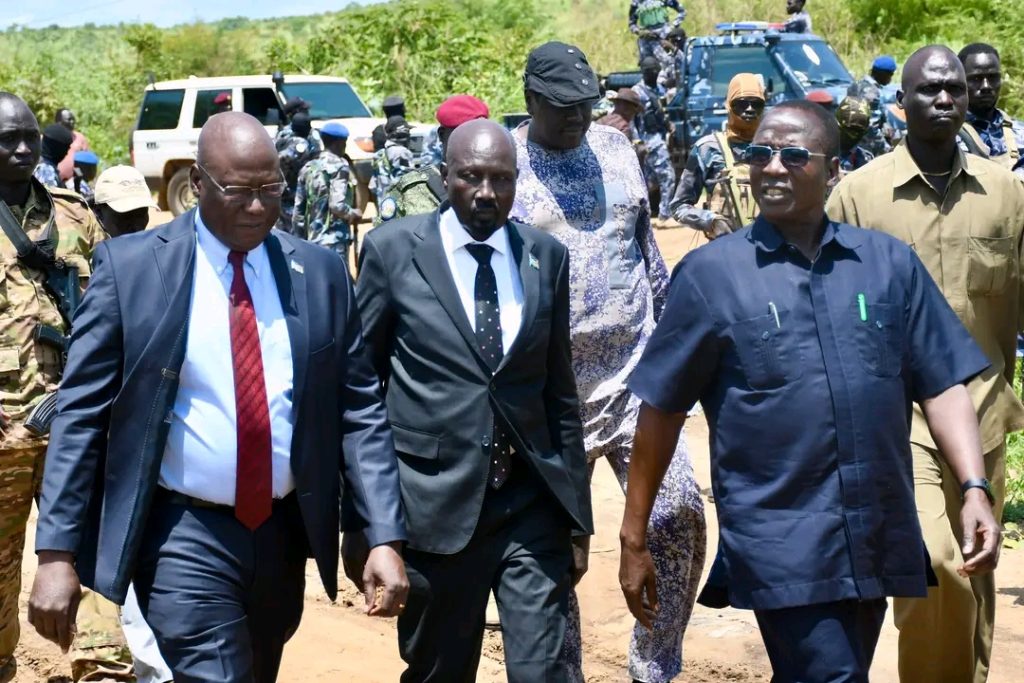
The directive was issued by the committee’s Chairperson, General Pieng Deng Kuol, during a fact-finding mission to Nimule, South Sudan’s busiest border crossing point, where the committee assessed challenges affecting trade, revenue collection, and the movement of goods along the country’s major trade corridor.
General Pieng said security personnel should only stop vehicles for legitimate security operations and allow all revenue collection activities to be handled through authorized government institutions.
“This highway is the main highway that is left for South Sudan, and we want everyone who passes through here to be happy and to ease movement. We don’t want anybody to stop a truck and take anything from it. What is collected in Nimule, we will try to improve your situation. Don’t do it on your own. Let your government collect the revenue and see what will be given to you and what will be used for delivering your services,” General Pieng said.
During the visit, General Pieng, accompanied by the Commissioner General of the South Sudan Revenue Authority (SSRA), Ambassador Moun Deng Ajuet, inspected several security checkpoints along the Juba–Nimule Highway, including Jele, Ashuwa, Moli, Nyolo, Excom, and Korduluma.
At each location, the committee communicated its resolutions directly to officers deployed along the corridor.
The committee also recognized the challenges faced by security personnel serving along the highway since 2020 under the Combined Joint Security Operation, which was established to address insecurity and guarantee the safe movement of people and goods.
General Pieng acknowledged the concerns raised by security commanders and assured officers that the government would engage the leadership of different security institutions to find lasting solutions to operational challenges affecting personnel deployed along the highway.
“In our meetings in Nimule, your commanders have raised your challenges, and we have listened to them. Most of us here were commanders in the army, and we know what is supposed to be done for the army. Despite our situation, you are able to carry out your duties, and that is why I thank you despite the challenges,” he said.
“We are not going to promise to solve all your challenges, but as your leaders, together with President Salva Kiir Mayardit and other leaders, I believe many things will change,” General Pieng added.
To ensure compliance with the new directives, the committee announced the formation of a high-level implementation team comprising senior generals from the South Sudan People’s Defence Forces (SSPDF), the National Police Service, the National Security Service (NSS), and other organized forces.
The Minister of Interior will oversee and monitor the implementation process to ensure that all security checkpoints along the corridor comply with the committee’s resolutions.
The intervention is part of the government’s wider economic reform agenda aimed at improving the movement of goods, removing illegal roadblocks, facilitating trade, and strengthening lawful revenue collection systems through institutions such as the South Sudan Revenue Authority.
The Juba–Nimule Highway remains South Sudan’s main trade route, connecting the country to the East African region through Uganda and serving as the primary corridor for the movement of imported goods into the country.