UNICEF Faces US$20.4 Million Funding Gap in US$70.7 Million Emergency Appeal
By Sasuk Taban
The United Nations Children’s Fund (UNICEF) is facing a funding shortfall of US$20.4 million after mobilizing US$50.32 million of its US$70.7 million humanitarian appeal. The agency says additional funding is urgently needed over the next six months to sustain critical assistance for vulnerable children and families affected by ongoing humanitarian challenges.
As of 11 June 2026, 676 confirmed cases of Ebola and 136 confirmed deaths were reported in the DRC, and 19 confirmed cases and 2 confirmed deaths in Uganda, a UNICEF update report stated.
The two countries present distinct epidemiological and operational contexts. In the DRC, the outbreak is centered in Ituri Province, with transmission also reported in North Kivu and South Kivu.UNICEF states that it is deeply concerned about the Ebola outbreak affecting the Democratic Republic of the Congo (DRC) and Uganda.
The outbreak, caused by the Bundibugyo strain of Ebola virus disease for which there is currently no approved vaccine or specific treatment was officially declared in Ituri Province, eastern DRC, on 15 May 2026, although evidence suggests transmission may have begun several weeks earlier.
The World Health Organization (WHO) declared a Public Health Emergency of International Concern on 17 May, and UNICEF activated its highest emergency classification (Level 3 Corporate Emergency) within 48 hours to enable a rapid, organization-wide response. To date, UNICEF has procured more than US$3.3 million in supplies for the response in DRC and Uganda a9s well as to support readiness efforts at neighboring at-risk countries.
UNICEF states that response efforts are being carried out in a challenging operational environment characterized by insecurity, population movements, and humanitarian access constraints, which continue to complicate surveillance, contact tracing, and case management. Community-based transmission continues to accelerate, and the outbreak is expanding geographically, with new health zones affected, including internally displaced persons (IDP) sites in and around Bunia.
On 7 June, the Inter-Agency Standing Committee (IASC) activated an IASC System-Wide Scale-Up for the Control of Infectious Disease Events in the DRC, for an initial period of three months.
The activation focuses on strengthening coordinated political engagement, reinforcing unified humanitarian coordination, and ensuring balanced funding and advocacy across the broader humanitarian response.
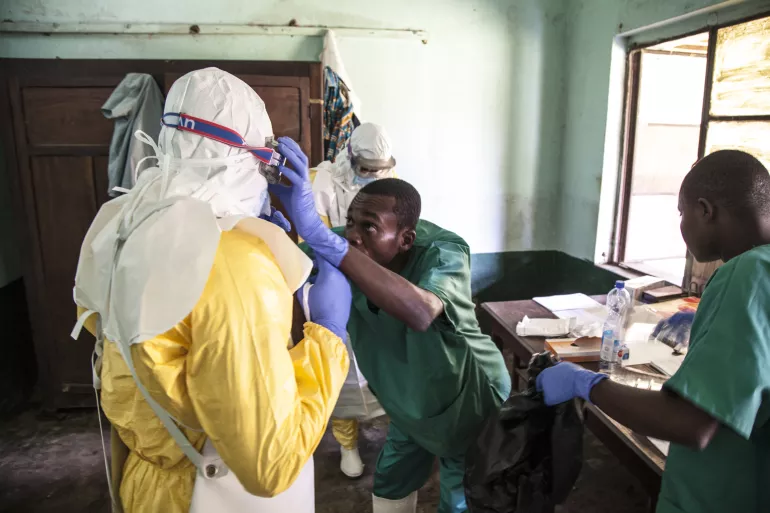
UNICEF, with WHO, Africa CDC, and other partners, is supporting the National Institute of Public Health (INSP) to strengthen the government-led Ebola response in eastern DRC, including through strategic field missions to Mongwalu, Beni, and Butembo, reinforcing diagnostic capacity, safe patient care, rapid case detection, risk communication and community engagement, while supporting a coordinated effort to interrupt Ebola transmission.
In Uganda, where the outbreak remains confined to imported cases and primary contacts (drivers and health workers), UNICEF has reached 122,979 people with Ebola prevention messages and is supporting 19 children currently under the 21-day quarantine monitoring period.
UNICEF has continued to expand its operational presence in eastern DRC, with a team deployed to Butembo and presence being established in Beni, extending the response into North Kivu.Within affected districts in the DRC,1,000 community health workers and mobilisers have been trained, already reaching over 160,000 households with Ebola prevention messages. In Bunia and Rwampara, 75 decontaminations and 57 safe and dignified burials have been carried out by teams directly supported by UNICEF and partners.
- Abyei Administrative Area
- Ads
- Agriculture
- Business
- Central Equatoria
- Climate Change
- Conflict
- Covid-19
- Crime
- currency
- Diplomacy
- Eastern Equatoria
- Economy
- Education
- Election
- Entertainment
- Feature
- Features
- Greater Pibor
- Health
- Humanitarian
- Jobs
- Jonglei
- Jonglei State
- Lakes State
- National
- News
- Northern Bahr el Ghazal State
- OPED
- Opinion
- Peace Process
- Politics
- Politics
- Press Freedom
- Regional
- Science
- Sports
- States
- Tech
- Transitional Constitution
- Uncategorized
- Unity State
- Upper Nile State
- Warrap State
- Western Equatoria
- World
To date, UNICEF has procured more than US$3.3 million in supplies for the response in DRC, Uganda, and readiness at neighboring at-risk countries.