International Medical Corps Expands Ebola Response as Outbreak Threatens Regional Health Security
Credit: IMC
International Medical Corps (IMC) has intensified its Ebola Virus Disease (EVD) response across the Democratic Republic of the Congo (DRC), Uganda and South Sudan as the Bundibugyo strain outbreak continues to spread, posing a significant regional health threat.
The outbreak, officially declared by the DRC Ministry of Public Health, Hygiene and Social Welfare on May 15, has expanded into four provinces in the DRC and crossed into Uganda. The World Health Organization (WHO) has classified the outbreak as a Public Health Emergency of International Concern.
As of July 7, the DRC had recorded 1,708 confirmed Ebola cases and 580 deaths, while Uganda reported 20 confirmed cases and two deaths. France has also confirmed one imported case involving a healthcare worker returning from the DRC.
South Sudan has not recorded any confirmed cases, although health authorities continue to classify the country as high risk due to porous border
The outbreak is caused by the Bundibugyo strain of the Ebola virus, for which there is currently no approved vaccine or specific treatment. Response efforts therefore focus on early detection, supportive care, infection prevention and control (IPC), contact tracing and community engagement.
International Medical Corps, with support from the United States Department of State, the European Commission’s Directorate-General for Civil Protection and Humanitarian Aid Operations (DG ECHO), and other donors, is working closely with governments and humanitarian partners to strengthen outbreak response across the three countries.
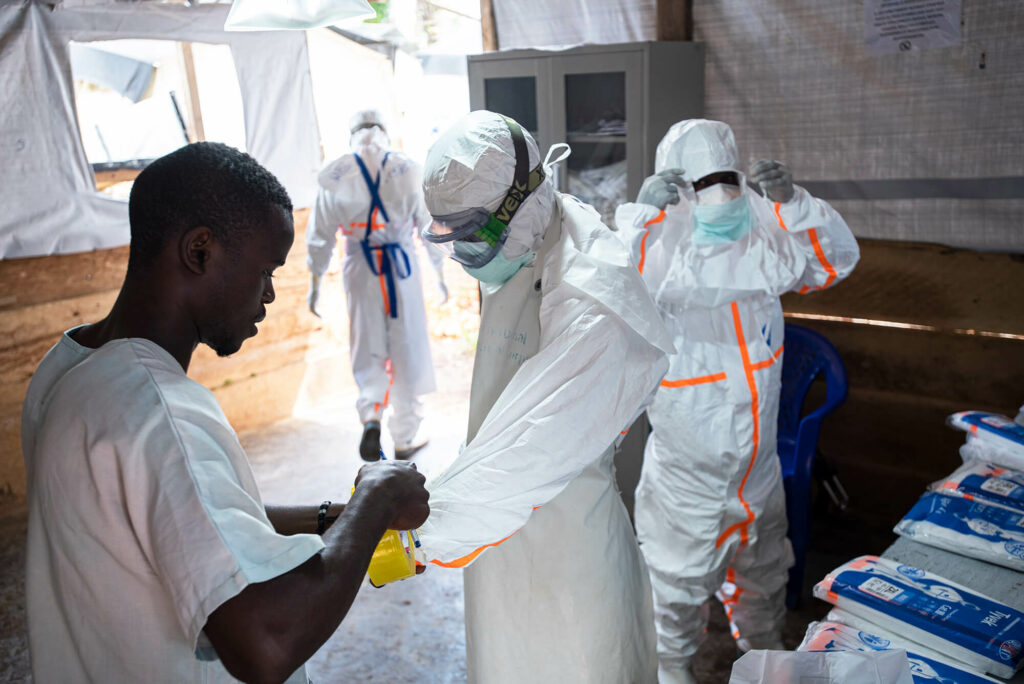
In the DRC, IMC operates a 60-bed Ebola Treatment Centre in Bunia, Ituri Province, which is currently operating beyond capacity. The organization is expanding the facility to 80 beds while continuing to provide treatment, screening, triage and infection prevention services. So far, the centre has managed 110 confirmed Ebola cases and discharged 18 recovered patients.
Additional Ebola treatment and transit centres are operating in North Kivu and South Kivu provinces, where IMC is also supporting healthcare facilities through infection prevention training, surveillance, laboratory referrals and mental health and psychosocial support.
The organization has trained more than 2,200 healthcare and community workers in Ebola case management, transmission prevention and response protocols across the DRC.
Community awareness activities have also been scaled up through door-to-door campaigns, public discussions and community dialogue sessions aimed at promoting early reporting of symptoms, reducing misinformation and encouraging preventive behaviours.
In Uganda, International Medical Corps and its partner African Humanitarian Action continue to strengthen Ebola preparedness through screening, healthcare worker training, facility assessments and community engagement. During the past week alone, 174 people were screened for Ebola, with no suspected cases detected.Health teams have also distributed infection prevention supplies to high-risk districts while conducting radio programmes and community meetings to improve public awareness and combat misinformation.
Meanwhile, South Sudan remains on high alert despite having no confirmed Ebola cases.
International Medical Corps recently completed preparedness assessments in Maridi and Yambio counties, where facilities have been identified for upgrading into Ebola-compliant infectious disease units. Additional primary healthcare centres will receive staff training, medical supplies and isolation facilities to strengthen early detection and referral systems.
The organization is also working alongside WHO, UNICEF and South Sudan’s National Public Health Institute to train 90 national master trainers, who will later train frontline health workers across 15 high-risk counties in Ebola clinical management, occupational safety, psychosocial support and infection prevention.
UNICEF has donated emergency tents to expand isolation facilities in Nimule, while WHO has provided additional infrastructure for the Infectious Disease Unit in Juba.
Beyond the immediate health emergency, the United Nations Development Programme (UNDP) has warned that the Ebola outbreak is creating severe economic consequences across the DRC, Rwanda, South Sudan and Uganda.
The agency estimates that the DRC alone could lose more than one billion US dollars in economic output, with approximately 55,000 jobs at risk due to disruptions in trade, travel and livelihoods.
International Medical Corps said it remains committed to supporting ministries of health and humanitarian partners through case management, surveillance, infection prevention, water and sanitation services, mental health support and community engagement to prevent further spread of the disease and strengthen regional preparedness.