The Girl Who Was Almost Married at 10 Takes Her Story to the United Nations
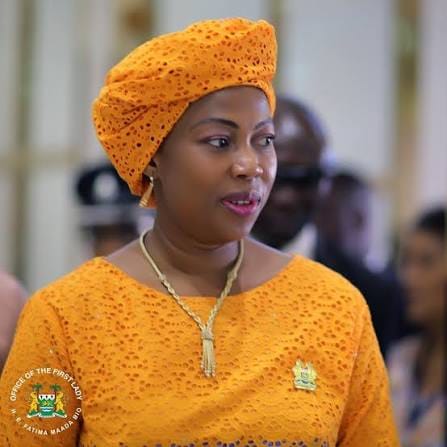
Cover Photo: Sierra Leone’s First Lady, Fatima Maada Bio
Sierra Leone’s First Lady returns to the global stage with a proposal to give the fight against child marriage its own international day
By Ahmed Sahid Nasralla
At about 10 years old, Fatima Maada Bio already knew who she was expected to marry.
She was a child, but an adult decision had been made about the direction her life should take. Somehow, she escaped that future.
On September 4 this week, many, many years after that little girl could have been sent into a marriage she did not choose, Sierra Leone’s First Lady is expected to stand before the United Nations General Assembly with a proposal aimed at protecting millions of girls from the same fate.
She is expected to present a draft resolution seeking the proclamation of November 27 as an ‘International Day for the Elimination of Child, Early and Forced Marriage’. The proposal is new. The date is not yet an official UN observance. It is a call for the international community to give the issue a permanent place on its calendar and, with it, sustained attention and action.
There is something deeply personal about that journey. According to briefing material from the Office of the First Lady of Sierra Leone, she knew at around the age of 10 who she was expected to marry and narrowly escaped child marriage. That experience, rather than becoming a footnote in her life, became part of the reason she has spent years speaking about the rights and protection of women and girls.
The First Lady’s public advocacy has taken her from communities in Sierra Leone to some of the world’s most important international forums. Her flagship ‘Hands Off Our Girls’ campaign has focused on ending rape, early marriage and violence against women and girls, while her work has also extended into girls’ education, women’s health and other issues affecting vulnerable communities.
However, her return to the United Nations this time carries a particularly personal weight. She is taking a subject that could have defined her own childhood and asking the international community to give it greater and lasting attention.
It is not her first attempt to put child protection on the UN agenda. In 2022, she spearheaded the effort that led the General Assembly to proclaim November 18 as the ‘World Day for the Prevention of and Healing from Child Sexual Exploitation, Abuse and Violence’. UNAIDS describes her as having championed the adoption of that first-ever World Day. The United Nations has also continued to strengthen its attention to child, early and forced marriage. In December 2024, the General Assembly adopted a resolution addressing the issue.
Sierra Leone has been moving on the national front too. The country enacted legislation in 2024 prohibiting marriage involving anyone under 18. So when Fatima Maada Bio walks into the General Assembly this week, she will be carrying a story that has travelled through several stages: from the experience of a young girl, to a national campaign, to legislation, and now to another attempt to secure a place for the issue on the global calendar.
The numbers behind the issue are sobering. The United Nations and other international organisations have consistently described child marriage as a major barrier to girls’ education, health, economic opportunity and personal autonomy. Behind every statistic, though, there is a girl whose childhood is being shortened. There is a school she may leave, friends she may lose, choices she may never get to make, and a future that may be decided for her before she is old enough to understand what that future means. That is why the personal history of the woman making this proposal is important.
Fatima Maada Bio knows what it means for adults to imagine a future for a girl before she has had the opportunity to imagine one for herself. She also knows what it means to get away. That gives her advocacy a particular human quality. The issue is something she encountered as a child and has carried into her public life as an adult.
The fight has also taken her beyond child marriage. Last week, OncoDaily named her among its 100 Influential Women in Oncology for 2026, recognising her work in women’s health and cancer prevention. The publication highlighted her partnership with the Merck Foundation, which has supported specialist medical training in Sierra Leone, including scholarships that contributed to the development of the country’s cancer-care workforce. It also noted her advocacy for breast cancer awareness and early detection and her participation in discussions around the WHO Global Breast Cancer Initiative. It is another part of a public role that has increasingly stretched beyond the traditional image of a First Lady.
Then there is child protection, and women’s health. There is girls’ education, and the wider question of how countries protect women and children who often have the least power over decisions affecting their lives.
The international recognition in oncology is significant for another reason. It shows that her advocacy is being noticed in fields far removed from the political spotlight in which First Ladies are usually seen. Nonetheless, the child-marriage campaign remains different. It brings her public work unusually close to her own childhood.
Sierra Leone, as a country, has its own reason to pay attention to what happens in New York this week. The country has already taken the important step of outlawing marriage involving children under 18. The First Lady has been one of the most visible voices pushing the protection of girls into the national conversation. Her campaign has also received international recognition, including her appointment by UNAIDS as a champion for the empowerment and engagement of adolescent girls and young women.
Now she is taking the conversation back to the United Nations. The proposed international day would not, by itself, end child marriage. A date on the UN calendar cannot keep a girl in school, or protect her from an abusive household or change the circumstances that make families vulnerable to marrying off their daughters. Those things require laws, enforcement, education, economic opportunity, social protection and changes in attitudes that can take generations.
But international days can keep issues alive. They create opportunities for governments, schools, civil society organisations, communities and international agencies to return to a problem every year, measure progress and remind themselves of what remains unfinished. That is the opportunity behind November 27.
This may also be the reason why the story of the little girl who nearly became a child bride is worth remembering when Fatima Maada Bio enters the General Assembly. She is no longer that girl. She got education and became a journalist, an actress, an advocate, a mother, and Sierra Leone’s First Lady. She also became the President of the Organisation of African First Ladies for Development. She is now asking the world to give millions of girls something she was fortunate enough to have: the chance to grow up and become all of that and even more before someone else decides what their lives should become.
That is what, on behalf of Sierra Leone and the world, she is carrying into the United Nations on September 4. Not a speech or a title. She is carrying a powerful story the General Assembly should listen and act on.