WFP Assists 1.8 Million People in Ethiopia Amid Worsening Humanitarian Crisis
Credit: Medafrica times
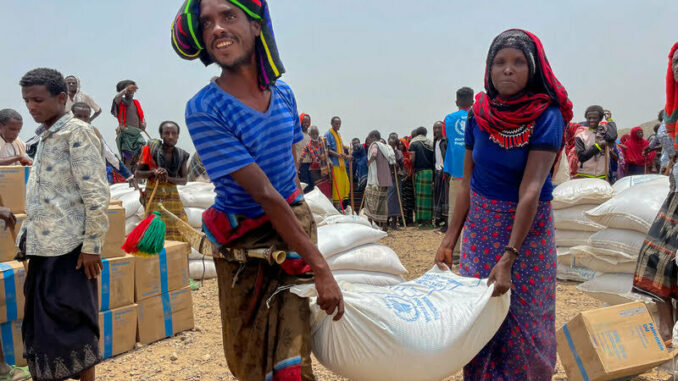
The United Nations World Food Programme (WFP) provided food and cash assistance to 1.8 million vulnerable people across Ethiopia in June as conflict, displacement, economic pressures and climate shocks continued to drive humanitarian needs.
According to WFP’s July 2026 Country Brief, the agency distributed 10,700 metric tonnes of food and transferred US$4.5 million in cash assistance through emergency food relief, nutrition programmes, school feeding initiatives and resilience-building activities. WFP also announced that it will begin providing food assistance to newly arrived refugees from South Sudan in the Gambella Region.
Although Ethiopia’s economy continues to record strong growth, WFP said humanitarian needs remain acute. Ongoing insecurity in the Tigray, Amhara, Oromia and Somali regions continues to disrupt livelihoods and restrict humanitarian access, while recurrent drought, floods and rising living costs have deepened food insecurity.
The agency estimates that Ethiopia is hosting about 1.1 million refugees, including people fleeing conflicts in Sudan and South Sudan, alongside approximately 1.9 million internally displaced people. Fuel shortages, fertilizer supply disruptions and rising food prices have further increased pressure on vulnerable households, while malnutrition remains widespread among children and pregnant and breastfeeding women.
During June, WFP reached more than 195,000 people with emergency food assistance in the Somali and Oromia regions. Relief operations, however, were affected by fuel shortages, transport constraints and insecurity, while ethnic clashes temporarily disrupted cash distributions in parts of the Somali Region before they resumed in early July.
Funding shortages have also forced WFP to reduce cereal rations to 60 percent of the standard allocation in an effort to maintain food supplies through August.
In the nutrition sector, WFP supported more than 449,000 children under five and pregnant and breastfeeding women through programmes treating moderate acute malnutrition. The agency also provided school meals to nearly 409,000 children attending more than 1,000 schools across Afar, Amhara, Oromia and Southern Ethiopia.
To strengthen long-term food security, WFP supported more than 40,500 households with climate-smart agriculture, irrigation, livelihood development and financial inclusion programmes across seven regions. In Gambella, refugee and host community farmers participated in joint farming initiatives aimed at improving agricultural production and promoting peaceful coexistence.
WFP said it requires US$182 million to sustain its humanitarian operations in Ethiopia over the next six months, warning that additional funding is urgently needed to continue assisting millions of people facing hunger and displacement.