
























Over 30 women trained on livelihood skills
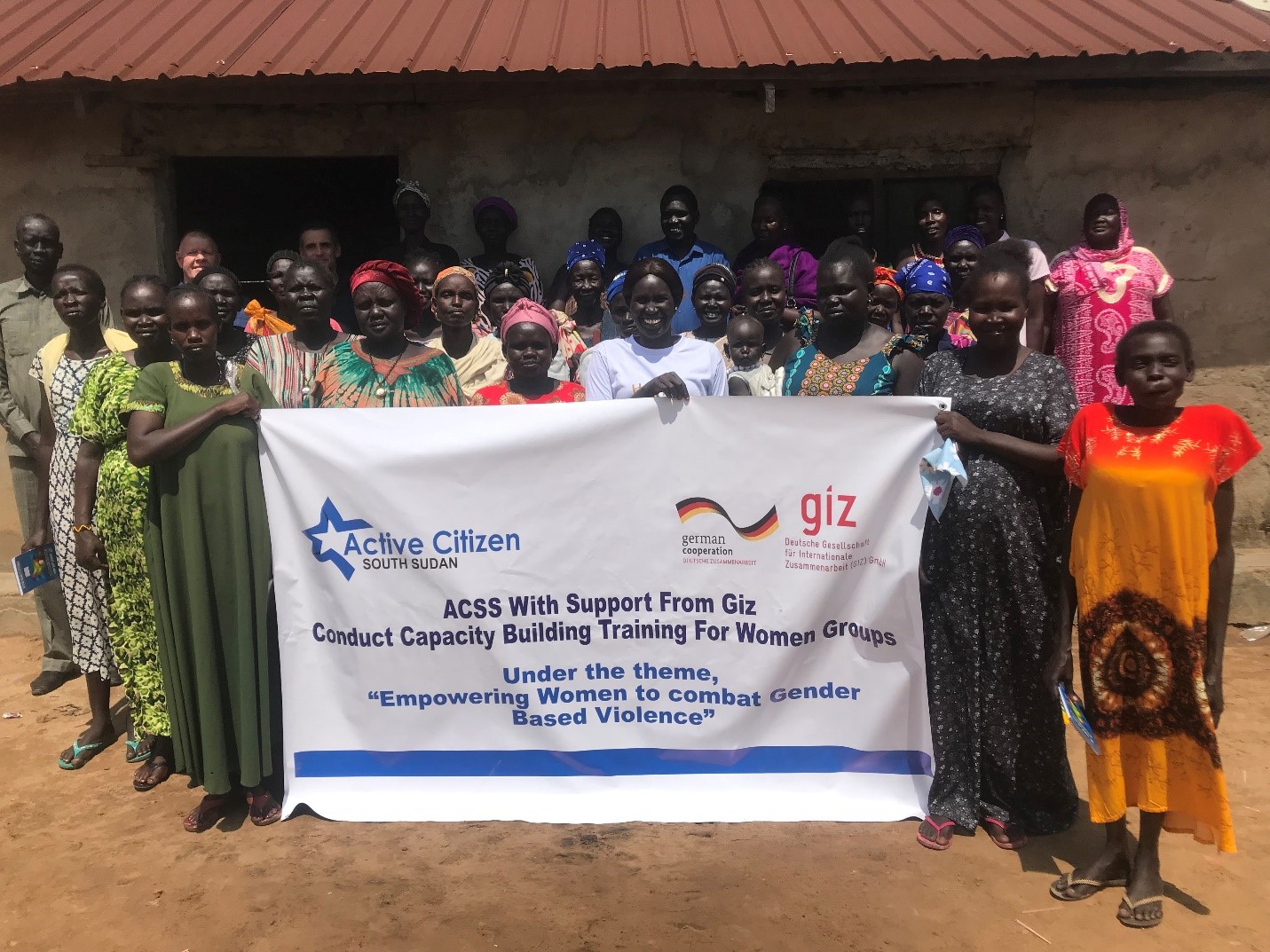
In an attempt to provide women in Gumbo-Shirikat with necessary livelihood skills, Active Citizen South Sudan (ACSS) in partnership with Deutsche Gesellschaft für Internationale Zusammenarbeit (GIZ) has trained about 33 women groups in various life skills meant to strengthen their capacities.
The training is expected to empower women with healthier and safer lifestyles, more effective learning, increased income generation, and improved standard of living.
Gai Makiew Gai, the project officer for ACSS said that empowering women with economic skills was essential to allow them to participate in the household decision-making process.
“In the bigger picture, we project that women’s economic capacities are strengthened as well as their participation in the decision-making process. This contributes to their economic stability,” he explained.
“The equipped workforce would be able to support their children by paying school fees and provide for their health and other necessities like clothing. So, this activity will be part and partial of household and income-generating activities,” he added.
According to Gai, the project was vital to transform and improve the local understanding of women’s business operations.
The event theme “Empowering women to combat gender-based violence” was also meant to raise awareness of sexual gender-based violence (SGBV).
Denis Simon, the Programme Manager of the GIZ project “Strengthening the Peace Process in South Sudan (StrePP) which is commissioned by the German Federal Foreign Office, confirmed that the cooperation with the implementing partner contributes to supporting the peace, security, and transitional process in the country.
“On behalf of the German government GIZ through the cooperation with Active Citizen South Sudan supports activities to fight SGBV, raise awareness and also provide women in Gumbo-Shirikat with necessary livelihood skills,” he stated.
Most livelihood projects equip locals with skills and business-planning tactics which are crucial for societal progress.
Simon hopes the initiative boosts women’s empowerment within the community, too.
“We want to see that women are empowered to fight all forms of SGBV, and it is also important to raise the community’s awareness concerning this topic,” he reiterated.
By bringing the community members together to discuss skills that improve their capacities, Simon said such events especially the livelihood training offers a suitable forum to debate ways and methods to fight all forms of sexual gender-based violence.
Elizabeth Ajah Arok, one of the group team leaders among the women’s groups, believes the project would transform their lives.
“This is the first time for us to get this training. So, we believe that the program will equip us with the necessary skills because it has never happened to us and so we are hoping for the best,” she said.
The 35-year-old woman who operates a small-scale business in Shirkat said she was eager to learn the skills and apply them in her daily business operations.
“I have been in the local business field for some time now, working with my hands, so I hope to benefit from the training,” she stated.
“I used to work in a restaurant, prepare local alcohol as well, so if there is something like this, I am eager to learn skills,” she said.
The young woman hopes to get the skills from the training and necessary empowerment in a bid to translate them into her business activities
Another trainee, Amina Suru revealed that the local women faced livelihood-related challenges.
“As women, we are faced with several things; we don’t have help hands or support systems. We have continued to struggle with the families. Life is difficult. But since this training is initiated, we hope to benefit from it,” she stated.
The participant wished the implementing partners could give further support in the future for their businesses.