
























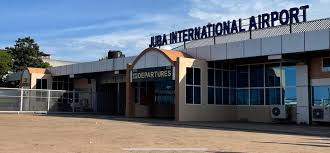
Main entrance gate of Juba International Airport will be temporarily closed from June 20th for renovation works.
By Wek Atak Kacjang
The Deputy Director General Manager for Juba International Airport, Engineer Mosety Kat Monyjok, announced that renovation work at the main entrance gate will start on Friday, June 20, 2025.
“The main entrance gate of Juba International Airport will be temporarily closed starting Friday, June 20, 2025, for renovation works, as announced by the airport management. This closure is part of the continuous efforts to upgrade infrastructure and improve service delivery at the busiest air travel hub in the country,”
During the renovation period, the exit gate of the airport will be used for both entry and exit purposes. Passengers, staff, and the general public are kindly asked to cooperate with airport personnel who will be managing traffic flow to ensure safety and convenience.
The management extends gratitude to airport users for their patience and support as improvement works continue.
Early History and Establishment
The history of Juba International Airport (JUB) is closely tied to the development of Juba, the capital city of South Sudan. This airport plays a vital role as a central hub for both domestic and international flights, managing passenger and cargo traffic, as well as chartered and military flights. It is one of two international airports in South Sudan, the other being Malakal Airport.
The initial clearing of the Juba airfield took place in 1929, with the Shell Company constructing the first runway in 1931, surfaced with crushed laterite. In February 1931, Imperial Airways launched the first leg of the weekly Croydon to Tanganyika Territory (now part of Tanzania) flight on the Cape to Cairo air-route, establishing a mooring spot near Rejaf, south of Juba, for their Calcutta flying-boats. These flying boats transported passengers between Khartoum and Kisumu.
Expansion and Development
The construction of the airport was a top priority for the Anglo-Egyptian colonial authorities, after Juba was selected as a key administrative and economic center for the southern region of Sudan around 1921. According to Juba elders, prisoners were used as forced labor to clear the land for the airport.
By 1976, the runway had been expanded to 2,400 by 45 meters and paved with asphalt. In early February 1977, the airport was the scene of an unsuccessful coup attempt. As of May 2011, Juba International Airport was undergoing upgrades and expansion, including enlarging passenger and cargo terminal buildings, resurfacing the runway, and installing runway lights for night operations.
Challenges and Incidents
In July 2014, plans were announced to extend the runway by 700 meters and resurface the existing 2,400-meter runway to create a new 3,100-meter runway. Construction for a new terminal building had begun in 2009 but was halted due to the outbreak of civil war in 2014. A new, smaller terminal was constructed on the original terminal site by the Chinese and was opened on October 29, 2018.
The airport’s history mirrors the broader challenges faced by South Sudan, such as political instability and insufficient investment in infrastructure.
Juba International Airport has encountered numerous challenges, including being ranked as one of the worst airports in the world in surveys conducted in 2016, 2017, and 2019. The airport has also witnessed several accidents and incidents, such as a nose-gear collapse of a Nova Airways Boeing 737-500 in 2013, an An-12BK crash in 2015, and an Ethiopian Airlines runway excursion in 2019.