Catholic bishops from South Sudan and Sudan have called on South Sudan's transitional government to address political, security and institutional chal...
Catholic bishops from South Sudan and Sudan have called on South Sudan's transitional government to address political, security and institutional challenges ahead of the December 22 general elections, warning that voting must be credible, peaceful and inclusive.In a communiqué issued after their 52nd annual plenary assembly in Torit, the bishops expressed concern over inadequate institutional, technical, financial and security preparations, incomplete transitional tasks, political mistrust, insecurity and displacement.The assembly, held from November 7 to 13, brought together Catholic bishops from the two countries under the Sudan and South Sudan Catholic Bishops' Conference (SSSCBC).The bishops said elections should not be treated merely as a political event or a date on the calendar but must reflect the will of the people and provide a peaceful and credible pathway towards constitutional democracy.They called on the Caretaker Government, the National Elections Commission (NEC), the Political Parties Council and other political actors to ensure that the electoral process is inclusive, transparent, peaceful and credible.The bishops also urged the government to engage opposition leaders and groups that are not signatories to the Revitalised Agreement on the Resolution of the Conflict in South Sudan (R-ARCSS) in genuine dialogue on constitutional and legal issues.They warned against unilateral political decisions and said the country should not be pushed into elections without the necessary conditions, while cautioning against an indefinite transitional period without accountability and a consensual legal basis.The statement emphasized that the National Elections Commission must operate independently and impartially, with adequate resources and freedom from political interference.It also called for meaningful participation of women, young people, persons with disabilities, internally displaced people and other marginalized groups in the electoral process.On security, the bishops urged authorities to establish professional and unified security arrangements, protect civic space, guarantee freedom of expression and peaceful assembly, and ensure equal protection for all candidates and voters.The religious leaders appealed to the Intergovernmental Authority on Development (IGAD), the African Union, the United Nations, the Troika and neighbouring countries to support an inclusive, nationally owned and peaceful democratic process.On Sudan, the bishops condemned the continuing war between the Sudanese Armed Forces and the Rapid Support Forces, expressing concern over killings, sexual violence, displacement and the destruction of homes, churches, mosques, schools, hospitals and other essential infrastructure.They called on all parties to cease hostilities, protect civilians, allow unhindered humanitarian access and respect international humanitarian and human rights law.The bishops also expressed concern about threats against Christian communities, clergy and church institutions in areas controlled by both warring parties, stressing that freedom of religion and conscience must be protected.The communiqué further highlighted worsening food insecurity, climate disruption, flooding, prolonged dry spells and loss of livelihoods in both countries.It called on governments, humanitarian organizations and development partners to strengthen food assistance, support farmers with seeds and tools, expand irrigation and water access, and invest in agricultural infrastructure and markets.The bishops also raised concerns about the vulnerability of communities to Ebola and other infectious diseases, particularly in areas bordering the Democratic Republic of Congo. They urged governments and partners to strengthen disease surveillance, public awareness, infection prevention, health infrastructure and cross-border cooperation.Other issues addressed included youth education, employment, vocational training, protection from exploitation and political manipulation, and responsible leadership.The bishops said the Church would continue supporting peacebuilding, reconciliation, humanitarian assistance, education and healthcare while urging political leaders to prioritize dialogue, justice, service and the common good.The communiqué was signed by Cardinal Stephen Ameyu Martin Mulla, president of the Sudan and South Sudan Catholic Bishops' Conference and Metropolitan Archbishop of Juba, on November 13 in Torit.Photo Credit: Eye Radio.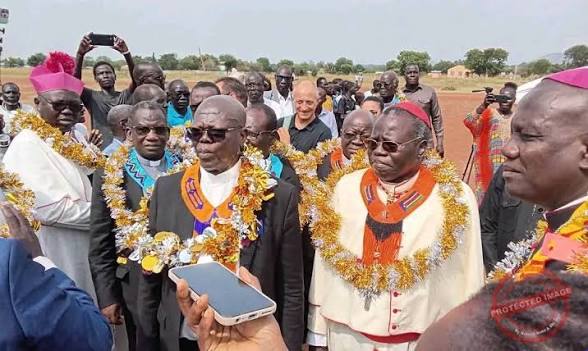
0 likes