China Calls for Reform of Global Governance System

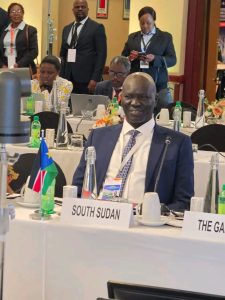
CEPO Executive Director, Edmund Yakani
China is calling for a more just and equitable global governance system, urging countries to strengthen multilateralism, uphold international law and give developing nations a greater voice in international decision-making.
The call is contained in a June 2026 white paper titled More Just and Equitable Global Governance: China’s Principles, Proposals and Actions, published by the State Council Information Office of the People’s Republic of China.
The document says the international community faces increasingly complex challenges, including conflicts, geopolitical tensions, economic fragmentation, climate change, food and energy insecurity, public health risks and emerging challenges linked to artificial intelligence.China argues that these challenges require stronger international cooperation and reforms to global governance institutions rather than unilateralism, protectionism and confrontation.
At the center of the proposal is the Global Governance Initiative (GGI), introduced by Chinese President Xi Jinping in 2025. The initiative is intended to address how global governance should be structured and how existing institutions can be reformed, according to the white paper.China says the initiative has received support from nearly 160 countries and international organizations, while more than 60 countries have joined the Group of Friends of Global Governance.
The GGI is based on five principles: sovereign equality, international rule of law, multilateralism, a people-centered approach and real actions. China says the principles are intended to promote a more representative, inclusive and effective global governance system.
The white paper places the United Nations at the center of the international system and calls for countries to uphold the UN Charter and international law. It also advocates greater participation by developing countries in global decision-making.
China says reforms are also needed in international financial institutions and the UN Security Council. It supports greater representation for developing countries and says Africa’s calls for increased representation on the Security Council should receive priority and special consideration.
The white paper describes the Global South as an increasingly important force in international affairs. It says developing countries account for more than 60% of the global economy based on purchasing power parity and contribute about 80% of global economic growth.
China also highlights its expanding cooperation with Africa, including partnerships covering modernization, trade, industrial development, connectivity, health, agriculture, livelihoods, green development and security.
The document further points to China’s contributions to UN peacekeeping, international development, climate action, food security, public health and artificial intelligence governance. It says more than 50,000 Chinese peacekeepers have participated in 29 UN-authorized peacekeeping operations.
On development, China highlights the Belt and Road Initiative and the Global Development Initiative as platforms for cooperation with developing countries. The white paper says China has signed cooperation documents with more than 150 countries and 30 international organizations under the Belt and Road framework.
China also calls for stronger international cooperation on climate change and artificial intelligence. The white paper advocates a people-centered approach to AI governance and international safeguards against potential security risks, including an AI arms race.
The document concludes that the world is at a critical juncture between two possible paths: one based on peace, dialogue and mutually beneficial cooperation, and another marked by conflict, confrontation and zero-sum competition.China says countries should work together to reform global governance and build what it describes as a more open, inclusive, just and equitable international system.