Charity warns of worsening humanitarian crisis amid funding cuts in South Sudan
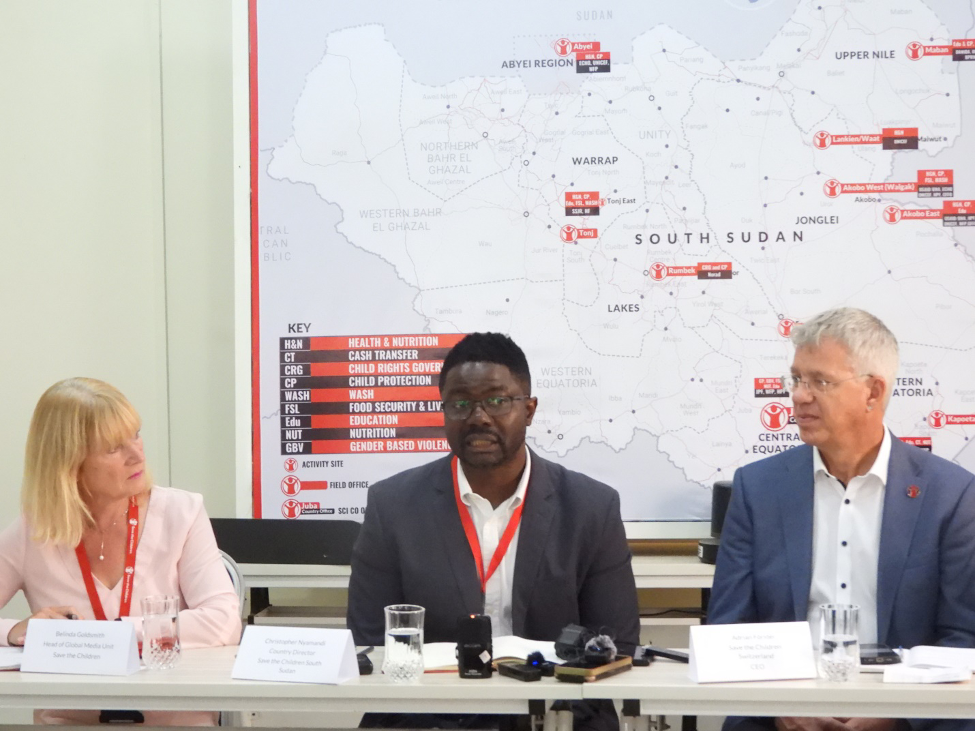
Christopher Nyamandi, country director of Save the Children in South Sudan (Left) speaks to journalists on Friday August 22, 2025 in Juba, the capital of South Sudan.
By Denis Ejulu
Global charity Save the Children on Friday said that South Sudan risks losing it’s next generation due to massive funding cuts to humanitarian assistance, leaving more than two million children suffering acute malnutrition unable to get required treatment.
Danny Glenwright, CEO of Save the Children in Canada, who was part of the high-level delegation that visited Maban, Upper Nile state and Bor in Jonglei state from August 17 to 22, said that he witnessed firsthand the impact of the aid cuts on health, education, nutrition and child protection.
“We saw the impact in the places where we went in both Bor and Maban of the aid cuts on health, on nutrition, on education and on child protection, and perhaps the last one, I think is the most critical for us because it sort of has tentacles into all the work that we do, and it has so many different challenges for the communities in which we work,” Glenwright told journalists in Juba.
He noted that the situation has been exacerbated by climate change and the ongoing war in neighboring Sudan, which has seen about 1.2 million people flee to South Sudan.
Highlighting the impact of the aid cuts on education for children in refugee camps in Maban, Glenwright said that the closure of Save the Children’s early childhood education centers will deny these children education and child friendly spaces their parents relied on in the past.
The majority of the refugees in Maban are Sudanese nationals who fled past conflicts in Sudan, and those who recently arrived due to the ongoing conflict there.
“I think that it leaves many children in these places with stories they hear from their parents and communities, how wonderful these educational spaces and in some cases the child friendly spaces that they knew from growing up in these refugee camps that are no longer there,” Glenwright said.
In addition, he said that these children are on the streets and lacking protection, which perpetuates the vicious cycles that really don’t allow the country to develop overall.
The Integrated Food Security Phase Classification (IPC) report released in June, noted that the overall malnutrition burden has increased to 2.3 million from 2.1 million children under the age of five experiencing acute malnutrition and in need of treatment in 2025, compared to the previous IPC projection.
“We are talking about a massive number of people who are at risk of malnutrition right now, at a time when Save the Children and other partners have had to reduce the number of nutrition centers we have, so in a city like Bor we have gone from having 22 nutrition centers to 15,” Glenwright said.
He warned that the existing nutrition centers with fewer staff may struggle to treat children and lactating mothers.
Meanwhile, Adrian Forster, CEO of Save the Children in Switzerland highlighted that this crisis comes at a time when already 70 percent of the population needs humanitarian assistance.
He noted that the humanitarian system is being overstretched due to the influx of refugees and returnees from Sudan, with hundreds of daily arrivals including the two million internally displaced people.
“People come and the food rations have been reduced, and there is not enough food for these people there, and of course our services had to be cut and it just shows this dimension how big it is and how challenging it is,” Forster said.
Christopher Nyamandi, country director of Save the Children in South Sudan noted that the funding cuts are not only from the U.S government but also the British government and other donor countries.
“So this is not just about the U.S government it is actually when I look at the figures, it looks like it is a global retreat from solidarity, which were used to in the past which unfortunately is affecting South Sudan in a remarkable way,” he said.
Nyamandi disclosed that South Sudan has depended upon humanitarian development aid for many years since independence, adding that 25 percent of it’s GDP comes from the international community.
“So this is going to have massive impact on the economic, as well as social conditions for children across the country,” he said.
Nyamndi also said that during their visit to the field, they were informed by both the government and communities about child abductions, recruitment of children into armed groups, including sexual violence against children and early child marriages.
“We continue to work with the government, civil society organizations to communicate the importance of zero tolerance towards these violations because the children of South Sudan just want to be children, they want to play with their friends, they want to be in school and they want to grow to become meaningful contributors to society in South Sudan,” he said.