South Sudanese yearn for peace, security amid political uncertainty due to fragile peace deal
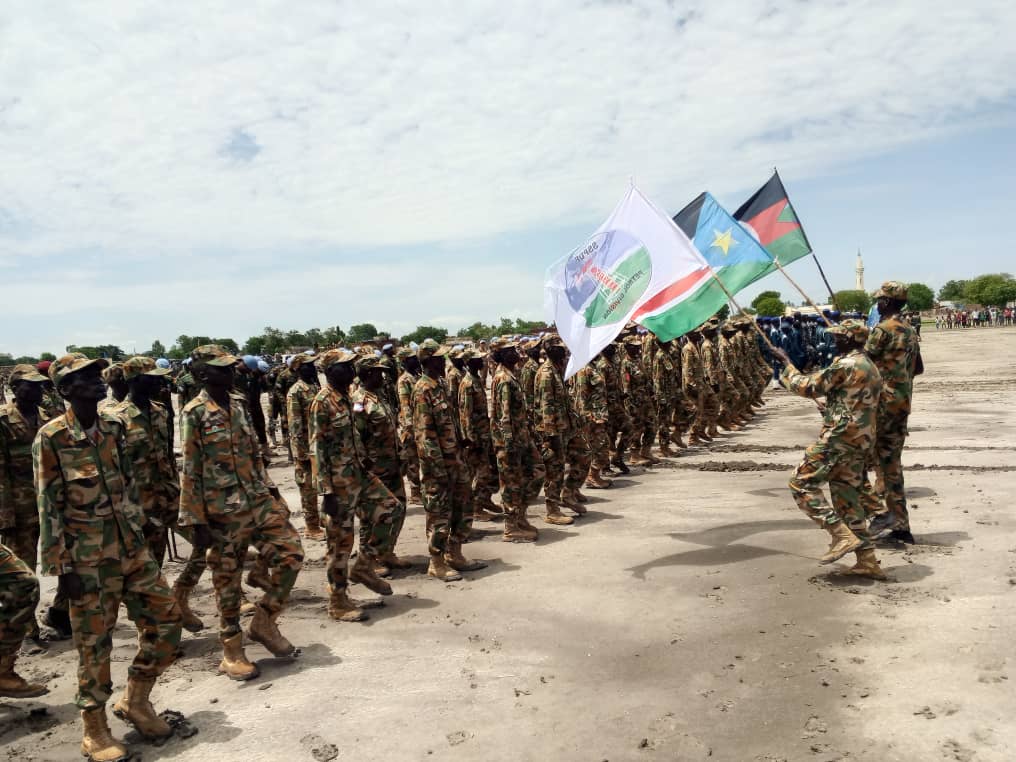
Photo of SSPDF soldier in Bentiu, Unity State, Photos by Ruai Malual Jal
By Denis Ejulu
South Sudan is once again at crossroads as it marked the 14th independence anniversary on Wednesday, following a deepening political crisis, which has sparked widespread fighting between government forces and opposition forces since March, this year.
The transitional unity government led by President Salva Kiir, is currently struggling to put out fires in the form of communal violence or defeating militia groups such as the White Army allied to the Sudan People’s Liberation Movement/Army-in opposition (SPLM/A-IO).
Samuel Yai Majok, a health worker in Wunrok primary health care center in Twic County of Warrap State, said insecurity remains a big challenge, with the recent report by the United Nations recording the highest number of victims of violence since 2020
At least 739 civilians were killed, 679 injured, 149 abducted, and 40 subjected to conflict-related sexual violence (CRSV) between January and March 2025.
“What is happening in other states is what I am also experiencing in my state, conflict has interrupted learning, health facilities and the rampant road ambushes have also curtailed movement along roads,” Majok told Juba Echo.
Majok noted that inter-communal fighting remains the major hindrance to peace and unity of the 64 tribes of the youngest nation, which won independence from Sudan in 2011.
“Now my fear is that if the fighting continues, then we should ask ourselves, what was the need for us to fight for our independence? We gained our independence, as the 64 tribes of South Sudan to remain as one community under one umbrella,” he said.
Majok noted that the upcoming elections planned for December 2026, after being postponed twice since 2022 depend on peace and security to succeed.
“I am expecting our government to establish some stability, to ensure that peace is in every state such that elections are held smoothly,” he said.
“I personally was not happy, when elections were postponed again in 2024 due to the conflicts in almost every community; I came to understand that even if elections are conducted in one or two states they would not be free and fair,” Majok added.
Majok also expressed fears about the ongoing fighting particularly in Nasir, Ulang counties in Upper Nile State and Fangak County in Jonglei State between the South Sudan People’s Defense Forces (SSPDF) and the SPLA-IO led by First Vice President, Riek Machar, who is currently under house arrest in the capital.
“Division within our top leaders within the transitional unity government creates division within our communities,” he said.
Nyadin Lual Gai,29, chairperson of Unity State youth union told Juba Echo from Bentiu, that there was no independence celebration in Mayom County, which was bombarded in May by government troops in a bid to flush out suspected opposition fighters.
“The community in Mayom County, is still living in fear, they are awaiting assurances of safety from the government,” she said.
Lual said that hopes for peace hinge on the planned peace conference, which is expected to bring youth from the area and those from neighboring states to discuss ending cattle raiding and revenge attacks.
“Our young people need to be engaged in activities such as technical vocational training, where they can acquire skills to do something and not think of engaging in cattle raiding and revenge killings,” Lual said.
Ter Manyang Gatwech, executive director of the center for peace and advocacy (CPA) said the post-independence leaders have since forgotten the promises that they made to the citizens during the liberation struggle for independence.
“Today majority of South Sudanese cannot afford or access food, our civil servants are not paid on time. There is no rule of law, human rights and accountability,” Gatwech said.
“We need a country, where every South Sudanese has enough food on the table and this is when we shall have a true meaning of independence,” he added.
Abraham Kuol Nyuon, dean of the School of Social and Economic Studies at the University of Juba, said that the 14th independence anniversary offers chance to reflect on the country that all South Sudanese aspired for prior to independence.
“This independence is not worth celebrating this year, because when people were fighting for the liberation of South Sudan all tribes were united, we were all brothers and sisters with no tribalism, no segregation, we were not dividing ourselves based on what we want,” Kuol said.
“Now after independence, we had people who believe that they have liberated this country, and these people who think that they liberated this country are even misleading the president, they are our problem,” he added.